Tuesday, January 1, 2013

Electric Current


In a given time interval t, let q+ be the net amount of positive charge that flows in the forward direction across the area. Similarly, let q– be the net amount of negative charge flowing across the area in the forward direction.

The net amount of charge flowing across the area in the forward direction in the time interval t, then, is q = q+ – (q–). This is proportional to t for steady current and the quotient, I = q/t

I is defined to be the current across the area in the forward direction. (If it turns out to be a negative number, it implies a current in the backward direction.)

we define the current as follows.

Let ∆Q be the net charge flowing across a cross-section of a conductor during the time interval ∆t [i.e., between times t and (t + ∆t)].

Then, the current at time t across the cross-section of the conductor is defined as the value of the ratio of ∆Q to ∆t in the limit of ∆t tending to zero.

In SI units, the unit of current is Ampere.

Current Carriers


The charges particles whose flow in a definite direction constitutes the electric current are called current carriers.

In solid conductor: free valance electrons are the charge carriers

In liquid: Negatively and positively charged ions are the charge carriers

In gas: Positive ions and the electrons are the charge carriers.

Current Electricity


Charges in motion constitute an electric current. Such currents occur naturally in many situations. Lightning is one such phenomenon in which charges flow from the clouds to the earth through the atmosphere, sometimes with disastrous results.

The net flow of charge in a direction through a conductor is called electric current. The branch of physics which deals with the charge in motion is called current electricity.

Parallel Plate Capacitor with a Dielectric Slab


Spherical or Cylindrical conductors

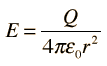
The capacitance for spherical or cylindrical conductors can be obtained by evaluating the voltage difference between the conductors for a given charge on each. By applying Gauss' law to an charged conducting sphere, the electric field outside it is found to be

The voltage between the spheres can be found by integrating the electric field along a radial line:

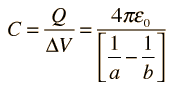
From the definition of capacitance, the capacitance is


For a cylindrical geometry like a coaxial cable, the capacitance is usually stated as a capacitance per unit length. The charge resides on the outer surface of the inner conductor and the inner wall of the outer conductor. The capacitance expression is


Lightning Conductor

A lightning conductor is a metal rod or metallic object mounted on top of a building, electrically bonded using a wire or electrical conductor to interface with ground or "earth" through an electrode, engineered to protect the building in the event of lightning strike. If lightning hits the building it will preferentially strike the rod and be conducted to ground through the wire, instead of passing through the building, where it could start a fire or cause electrocution.
A lightning rod is a single component in a lightning protection system. Lightning rods are also called finials, air terminals or strike termination devices. The lighting rod requires a connection to earth to perform its protective function. Lightning rods come in many different forms, including hollow, solid, pointed, rounded, flat strips or even bristle brush-like. The main attribute of all lightning rods is they are conductive.

Copper and its alloys are the most common materials used in lightning protection.

Action of Sharp Points (Corona Discharge)

In electricity, a corona discharge is an electrical discharge brought on by the ionization of a fluid surrounding a conductor that is electrically energized. The discharge will occur when the strength (potential gradient) of the electric field around the conductor is high enough to form a conductive region, but not high enough to cause electrical breakdown or arcing to nearby objects. 

It is often seen as a bluish (or other color) glow in the air adjacent to pointed metal conductors carrying high voltages. Spontaneous corona discharges are undesirable where they waste power in high-voltage systems or where the high chemical activity in a corona discharge creates objectionable or hazardous compounds, such as ozone. Controlled corona discharges are used in a variety of filtration, printing and other processes.

Van De Graaff Generator


This is a machine that can build up high voltages of the order of a few million volts. The resulting large electric fields are used to accelerate charged particles (electrons, protons, ions) to high energies needed for experiments to probe the small scale structure of matter.

The principle underlying the machine is as follows. Suppose a large spherical conducting shell of radius R, on which we place a charge Q. This charge spreads itself uniformly all over the sphere.

The field outside the sphere is just that of a point charge Q at the centre; while the field inside the sphere vanishes. So the potential outside is that of a point charge; and inside it is constant, namely the value at the radius R. We thus have: Potential inside conducting spherical shell of radius R carrying charge Q is equal to constant.
 Suppose that in some way we introduce a small sphere of radius r, carrying some charge q, into the large one, and place it at the centre. The potential due to this new charge clearly has the following values at the radii indicated:

Potential due to small sphere of radius r carrying charge q

 Taking both charges q and Q into account we have for the total potential V and the potential difference the values

Assume now that q is positive. We see that, independent of the amount of charge Q that may have accumulated on the larger sphere and even if it is positive, the inner sphere is always at a higher potential: the difference V(r)V(R) is positive. 

The potential due to Q is constant upto radius R and so cancels out in the difference. This means that if we now connect the smaller and larger sphere by a wire, the charge q on the former will immediately flow onto the matter, even though the charge Q may be quite large.


The natural tendency is for positive charge to move from higher to lower potential. The potential at the outer sphere would also keep rising, at least until we reach the breakdown field of air.

It is a machine capable of building up potential difference of a few million volts, and fields close to the breakdown field of air which is about 3 × 10⁶ V/m.

Construction of Van de Graff generator

A large spherical conducting shell (of few metres radius) is supported at a height several meters above the ground on an insulating column. A long narrow endless belt insulating material, like rubber or silk, is wound around two pulleys – one at ground level, one at the centre of the shell. This belt is kept continuously moving by a motor driving the lower pulley. It continuously carries positive charge, sprayed on to it by a brush at ground level, to the top.

There it transfers its positive charge to another conducting brush connected to the large shell. Thus positive charge is transferred to the shell, where it spreads out uniformly on the outer surface. In this way, voltage differences of as much as 6 or 8 million volts (with respect to ground) can be built up.

Dielectric Strength

Dielectric strength is the maximum value of the electric field intensity that can be applied to the dielectric without its electric break down. Its SI unit is V m-1.  Its practical unit is kV mm-1.


Non-Polar and Polar Dielectrics


DIELECTRICS AND POLARIZATION

Dielectrics are non-conducting substances. In contrast to conductors, they have no or negligible number of charge carriers.

In a dielectric, free movement of charges is not possible. It turns out that the external field induces dipole moment by stretching or re-orienting molecules of the dielectric.

The collective effect of all the molecular dipole moments is net charges on the surface of the dielectric which produce a field that opposes the external field.
             
 The molecules of a substance may be polar or non-polar. In a non-polar molecule, the centres of positive and negative charges coincide. The molecule then has no permanent (or intrinsic) dipole moment.


Examples of non-polar molecules are oxygen (O2) and hydrogen (H2) molecules which, because of their symmetry, have no dipole moment.

On the other hand, a polar molecule is one in which the centres of positive and negative charges are separated (even when there is no external field). Such molecules have a permanent dipole moment.


An ionic molecule such as HCl or a molecule of water (H2O) is examples of polar molecules.

The non-polar molecule thus develops an induced dipole moment. The dielectric is said to be polarised by the external field.

Substances for which this assumption is true are called linear isotropic dielectrics.

The induced dipole moments of different molecules add up giving a net dipole moment of the dielectric in the presence of the external field.

Thus in either case, whether polar or non-polar, a dielectric develops a net dipole moment in the presence of an external field. The dipole moment per unit volume is called polarisation and is denoted by P. For linear isotropic dielectrics