

Sunday, January 20, 2013


Saturday, January 12, 2013
Torque on a Bar Magnet in a Magnetic Field
Let a bar magnet makes angle θ with magnetic field B and 2l
be the length of the bar as show in figure.

Force on N-pole = mB along B and Force on S-pole = mB,
opposite to B, since these are the equal and opposite forces they produce
torque
ז = force x perpendicular distance. =
mB x NA = mB x 2lsinθ therefore ז =MBsinθ
The direction of the torque is perpendicular to the the plain
containing M and B, and given by right handed screw rules.
Magnetic dipole moment as the torque acting on a dipole held
perpendicular to uniform magnetic field of unit strength
SI unit of M is JT-1
Bar Magnet as an Equivalent Solenoid
To demonstrate the similarity of a current carrying solenoid to
a bar magnet, let us calculate axial field of a finite solenoid carrying
current.
Consider: a
= radius of solenoid
2l =
length of solenoid with centre O
n
= number of turns per unit length
I =
current passing through solenoid
OP =
r

Consider a small element of thickness dx
of solenoid at distance x from O. and number of turns in element
=
n dx.
We know magnetic field due to n turns coil at axis
of solenoid is given by

It is clear from the above
expression that magnetic moment of a bar magnet is equal to the magnetic moment
of an equivalent solenoid that produce the same magnetic field.
Current Loop as a Magnetic Dipole
When we see a current carrying loop from top,
current direction is anticlockwise and has north polarity. If, lower face of
loop is seen from bottom then current direction is clockwise and have south
polarity. Overall it behaves as a magnetic dipole depends upon

It is the magnetic moment of one turn loop of area
one square metre carrying a current of one ampere.
NI factor is called as ampere turns of circular current loop


Magnetic Dipole
Magnetic dipole consists to two unlike poles of equal strength
and separated by a small distance.
The distance between the two poles of the bar is called magnetic length of the magnet.
It is a vector directed from S-pole to N-Pole and represented by 2l.


Magnetic dipole is the product of the strength of either dipole
(m)
or the magnetic length (2l) of the magnet. It is represented by M.

It is vector quantity directed from South to North Poles.SI unit
of M is ampere-meter2 or joule/tesla.
Properties of Magnetic Field Lines
- Magnetic field lines of a magnet form closed continuous
loops. These lines are not discontinuous as of electric field.
- Outside the body of magnetic direction of lines is from
North Pole to South Pole.


- Tangent to field line at any point gives the direction of
magnetic field at that point.

- Crowded lines represent a strong magnetic field and distant
lines represent a weak magnetic field.
- No two magnetic field lines can intersect the each other.
Magnetic field cannot have two tangent directions at a same point on line.
The Magnetic Field Lines
A space around a magnet or a conductor carrying current, in
which force of attraction or repulsion on a magnet can be perceived is called magnetic field. Faraday introduces
magnetic field line to visualize the existence of the lines.
According to the Faraday magnetic field lines are the imaginary
curve, tangent to which at any point gives the direction of magnetic field at
that point. The path along with compass needle is aligned is known as the magnetic field lines.
Some Basics of Magnetism
- Earth behaves as a magnet: This is as if a big magnet is
held at the center of the earth with its north pole pointing towards
geographic South Pole and South Pole pointing geographical North as shown
in the figure.

- Every magnet attracts small pieces of iron, cobalt, nickel
and steel towards it .The attraction is maximum at the two ends of a
magnets.
- When a magnet is suspended freely with the help of thread,
it comes to rest along the north south direction. The pole of magnet which
points towards geographic north is called North Pole and opposite end facing towards geographic south is
call South Pole.
- Poles exist in pairs; two poles of magnet are always of
equal strength. The magnetic length of magnet is 6/7 of actual length of
the magnet.
- A straight line XX’ passing through the south and North
Pole is called as axial line.
And a line YY’ passing through the centre and perpendicular to length is
called equatorial line.
- A plane passing through N-S line of a freely suspended
magnet is called magnetic meridian.

- Like poles repel each other and unlike pole attract each other.

- The force of attraction and repulsion F between two
magnetic poles of strength m1 and m2 separated by a distance r is directly
proportional to the product of poles strength and inversely proportional
to the square of the distance between the centres.

Magnetic poles said to be one ampere-meter, if it
repel s and equal and similar pole with a force of 10-7 N, when
placed in vacuum at a distance of one meter.
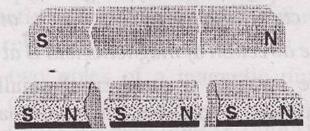
- The magnetic poles exist in pairs and do not exist in
monopole. Each piece of a broken magnet is a complete magnet in itself.
Isolated magnetic north and south poles are called monopoles and they do
not exist.
- When a piece of magnetic material is places near to a
magnet, it acquires magnetism. The magnetism so acquired is called induce magnetism and the property
of magnet is called inductive
property.
- Repulsion
is sure test of magnetism.
Two bar magnets repeals each other’s similar poles but they attract the
iron piece with both the poles.
Subscribe to:
Posts (Atom)