Monday, November 26, 2012

Electric Flux


 Electric flux over an area in an electric field represents the total number of field lines crossing this area.

The number of field lines crossing a unit area, placed normal to the field at a point is a measure of the strength of electric field at that point.

If we place a small planar element of area ΔS normal to E at a point, the number of field lines crossing it is proportional to E ΔS.

If we tilt the area element by angle θ, the number of field lines crossing the area element will be smaller. The projection of the area element normal to E is ΔS cosθ.

Thus, the number of field lines crossing ΔS is proportional to E ΔS cosθ. Hence


Area Vector


Area is a scalar quantity, but in some the problems, it is convenient to treat it as vector. A small area can be treated as planar. As normal to the plane specifies the orientation of plane, therefore, the direction of planar area vector is along its normal.

By convention, the vector associated with every area element of a closed surface is taken to be in the direction of the outward normal.


Potential Energy of A System of Charges


Consider the charges q1 and q2 initially at infinity and determine the work done by an external agency to bring the charges to the given locations.

Suppose, charge q1 is brought from infinity to the point r1. There is no external field against which work needs to be done, so work done in bringing q1 from infinity to r1 is zero. This charge produces a potential in space given by
where r1P is the distance of a point P in space from the location of q1.

From the definition of potential, work done in bringing charge q2 from infinity to the point r2 is q times the potential at r2 due to q1:
where r12 is the distance between points 1 and 2.

If q1q2 > 0, Potential energy is positive. For unlike charges (q1 q2 < 0), the electrostatic force is attractive.

Potential energy of a system of three charges q1, qand q located at r1, r2, r, respectively. To bring q first from infinity to r1, no work is required. Next bring q2 from infinity to r2. As before, work done in this step is


The total work done in assembling the charges at the given locations is obtained by adding the work done in different steps,

 The potential energy is characteristic of the present state of configuration, and not the way the state is achieved.

Potential Energy In An External Field


Potential energy of a single charge

The external electric field E and the corresponding external potential V may vary from point to point. By definition, V at a point P is the work done in bringing a unit positive charge from infinity to the point P.

Work done in bringing a charge q from infinity to the point P in the external field is qV. This work is stored in the form of potential energy of q. If the point P has position vector r relative to some origin, we can write:

 Potential energy of a system of two charges in an external field

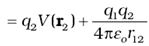
Work done in bringing the charge q1 from infinity to r1 is q1 V(r1). Consider the work done in bringing q2 to r2. In this step, work is done not only against the external field E but also against the field due to q1.
Work done on q2 against the external field

Work done on q2 against the field due to q1
  
By superposition principle for fields, add up the work done on q2 against the two fields. Work done in bringing q2 to r2

 Thus, Potential energy of the system = the total work done in assembling the configuration


Relation Between Field And Potential


Consider two closely spaced equipotential surfaces A and B Fig. with potential values V and V + δV, where δV is the change in V in the direction of the electric field E.

Let P be a point on the surface B. δl is the perpendicular distance of the surface A from P. Imagine that a unit positive charge is moved along this perpendicular from the surface B to surface A against the electric field. The work done in this process is |E|δl.

This work equals the potential difference VA –VB. Thus,

We thus arrive at two important conclusions concerning the relation between electric field and potential:

(i)            Electric field is in the direction in which the potential decreases steepest

(ii)           Its magnitude is given by the change in the magnitude of potential per unit displacement normal to the equipotential surface at the point.

Equipotential Surfaces


An equipotential surface is a surface with a constant value of potential at all points on the surface. For a single charge q, the potential is given by
This shows that V is a constant if r is constant. Thus, equipotential surfaces of a single point charge are concentric spherical surfaces centre at the charge.

No work in done in moving from one point to another in equipotential surface.

For a uniform electric field E, say, along the x -axis, the equipotential surfaces are planes normal to the x -axis, i.e., planes parallel to the y-z plane. Equipotential surfaces for (a) a dipole and (b) two identical positive charges are shown in Fig.


Potential Due To An Electric Dipole


Take the origin at the centre of the dipole. Since potential is related to the work done by the field, electrostatic potential also follows the superposition principle. Thus, the potential due to the dipole is the sum of potentials due to the charges q and –q
where r1 and r2 are the distances of the point P from q and –q, respectively.

Now, by geometry,
Take r much greater than a ( r >> a ) and retain terms only up to the first order in a/r
 Using the Binomial theorem and retaining terms up to the first order in a/r; obtain,

where rˆ is the unit vector along the position vector OP. The electric potential of a dipole is then given by
Equation is approximately true only for distances large compared to the size of the dipole, so that higher order terms in a/r are negligible. For a point dipole p at the origin,

From Eq. potential on the dipole axis (θ= 0, π) is given by

(Positive sign for θ= 0, negative sign for θ= π.) The potential in the equatorial plane (θ= π/2) is zero.


(i)                 The potential due to a dipole depends not just on r but also on the angle between the position vector r and the dipole moment vector p.

(ii)               The electric dipole potential falls off, at large distance, as 1/r2, not as 1/r, characteristic of the potential due to a single charge.

Potential Due To A System Of Charges


Consider a system of charges q1, q2,…, qn with position vectors r1, r2,…, r n relative to some origin. The potential V1 at P due to the charge q1 is

 where r1P is the distance between q1  and P. Similarly, the potential V2 at P due to q2 and due to q are given by
where r2P and r3P are the distances of P from charges q2 and q3, respectively; and so on for the potential due to other charges.

By the superposition principle, the potential V at P due to the total charge configuration is the algebraic sum of the potentials due to the individual charges
The electric field outside the shell is as if the entire charge is concentrated at the centre. Thus, the potential outside the shell is given by

where q is the total charge on the shell and R its radius. The electric field inside the shell is zero. This implies that potential is constant inside the shell (as no work is done in moving a charge inside the shell), and, therefore, equals its value at the surface, which is


Potential Due To A Point Charge


Consider a point charge Q at the origin. For Q > 0, the work done against the repulsive force on the test charge is positive. Choose a convenient path along the radial direction from infinity to the point P.

At some intermediate point P′ on the path, the electrostatic force on a unit positive charge is
where rˆ′ is the unit vector along OP′. Work done against this force from r′ to r′ + ∆r′ is
The negative sign appears because for ∆r′ < 0, ∆W is positive. Total work done (W) by the external force is obtained by integrating from r′ = ∞ to r′ = r,


This, by definition is the potential at P due to the charge Q
 Figure below shows how the electrostatic potential ( ∝ 1/r) and the electrostatic field ( ∝ 1/r2 ) varies with r.

Electrostatic Potential

Work done per unit test charge is characteristic of the electric field associated with the charge configuration. This leads to the idea of electrostatic potential V due to a given charge configuration.

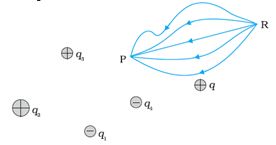
Work done by external force in bringing a unit positive charge from point R to P

where VP and VR are the electrostatic potentials at P and R, respectively.

Work done by an external force in bringing a unit positive charge from infinity to a point = electrostatic potential (V) at that point.

 In other words, the electrostatic potential (V) at any point in a region with electrostatic field is the work done in bringing a unit positive charge (without acceleration) from infinity to that point.

SI unit of Potential difference is Volt. 1V=1Nm C-1
___________________________________________________________________________________________

Some of these questions which may be asked in your Board Examination 2012-2013

Q1: When a plastic comb is passed through dry hair, what type of charge is acquire by comb?

Q2: Does motion of a body affect its charge
?

Q3: 
What is the origin of frictional forces
?

Answer these questions in comment box and help your friends